Guest: Luke Mickelson, founder, Sleep in Heavenly Peace · Host: Zaneta Chuniq Inpower
Sleep in Heavenly Peace is the largest bed-building charity in the world. It has trained more than 440 chapter presidents across almost every US state and four countries, and has built roughly 400,000 beds since 2018. Luke Mickelson started it in his garage in 2012, in an Idaho town of about four thousand people, and he spends a surprising amount of this interview trying to talk you out of being impressed by him.
That is the strategy, not modesty.
Some Dad In Some Podunk Town
Luke was thirty-five and, on paper, fine. Good job as an outside salesman, family, a life that looked complete. He was also restless in a way he could not name at the time, and later diagnosed as the absence of passion and purpose.
Then, in a church meeting, he heard about a family in his own town whose children were sleeping on a hardwood floor. He had lived there twenty-nine years and had never known the apartment complex existed. He built a bunk bed with his Boy Scouts and delivered it. Later he built another in his garage with his young daughter and son, no plan for where it would go, and posted it on a local Facebook buy-and-sell group. Strangers and old friends alike replied, all of them knowing a child sleeping on a floor.
He is emphatic about what that origin story does and does not prove:
“I’m a farm kid from Idaho. I’m nobody special. I really am not. And that’s important. I don’t want anybody to have an excuse that, I saw you on a podcast or TV or heard you on a radio or you started this big thing. So that started because some dad in some podunk town of Idaho wanted to teach his kids something and he got up off the couch. You know what? Anybody can do that.” — Luke Mickelson
He is not being humble; he is removing your exit. If the founder were remarkable, you would be off the hook.
True Joy When You Stop Thinking About Yourself
The delivery that settled it involved a six-year-old girl named Haley, who had never slept in a bed in her life. Her sleeping place had been the backseat of her mother’s car. The family had just moved out of homelessness into an empty house, and when Luke and his team arrived, Haley showed them her room: a corner with holes in the carpet, tears in the wallpaper, and a pile of school clothes she slept on — pants for a blanket, a shirt for a pillow.
When she understood what they were assembling, she hugged the two men she had just met. Then she hugged the bed. Then, as Luke tells it, “I’ve never seen a child so happy for a bed that she kissed it.” Her mother stood in the doorway crying, and Luke — raised by a single mother himself — says he knew what each of those tears meant. He knew something else in that moment too: “this is way more than just a bed.”
What he takes from it is not a fundraising line. It is closer to a personal remedy for the restlessness he could not name at thirty-five:
“I believe true joy comes when you stop thinking about yourself and you start thinking about someone else.” — Luke Mickelson
He is careful about the mechanism. Your problems do not disappear. They change proportion. Looked at after doing something for someone else, he says, a problem is usually “not the big hairy monster you thought it was” — it shrinks into something you can deal with, or something you work out you never needed to deal with at all.
You Might Not Change The World
Luke has a specific objection to the way world-changing gets talked about, and it is one every small organisation should probably steal:
“Listen, you might not change the world, but you’re gonna change someone’s world. And that world might just be yours, and that’s totally fine. That’s why we’re here.” — Luke Mickelson
The permission in the second half is the part people miss: being changed yourself is an acceptable outcome, not a selfish one. For anyone who has hesitated because their contribution felt too small to matter, that is the whole argument.
The scale of the problem makes his point for him. Child bedlessness is not a rare condition. Luke puts it at more than three percent of the total population of any given town on average — in a city of 100,000 people, roughly 3,000 children sleeping on the floor tonight. Child Protective Services and CASA workers told him the hardest single item to secure for a child is a bed. And almost nobody is working on it: there are barely any grants for it, virtually no federal support, and most people have never heard the problem named.
That, he says, is the only reason his organisation is the largest of its kind. Not funding, not brilliance. Nobody else is doing it.
How The Chapter Model Actually Works
Once Luke understood the size of the problem, he also understood that he could not solve it. His words: “child bedlessness is not gonna be solved by some farm kid from Idaho in your town.” The only thing he could do about it, he decided, “is teach people the way I did it… and provide that platform, that opportunity for someone to start a chapter in their area, bring their community together, and start building beds and delivering beds to kids.”
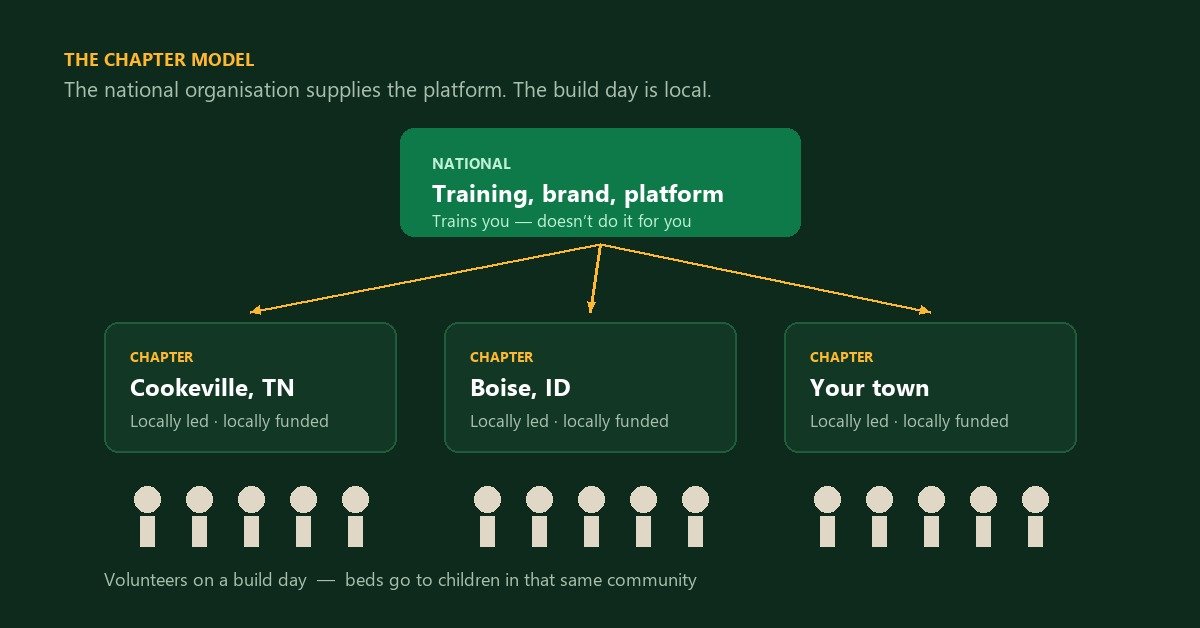
The national organisation supplies training, brand and platform. The chapter is locally led, locally funded and locally accountable. Even the website is built around that logic: type in your location and you land on your nearest chapter rather than a national homepage, because the point is to show you what is happening in your own town.
Luke is direct about where responsibility sits, and it is worth quoting because it is unusual for a charity founder to say out loud:
“This is not my responsibility. Now I feel responsible. But my responsibility is not to provide beds for your, kids in your community. That’s what your responsibility is. I’m just telling you that there’s a problem and there’s a solution. Now what are you going to do about it?” — Luke Mickelson
What he found, running it this way, is that there are millions of people who want to give back and simply do not know where or how. The chapter model is mostly an answer to that second problem rather than the first.
Starting A Chapter Where You Live
Sleep in Heavenly Peace covers about 28 percent of the United States geographically, with more than 160,000 children on its waiting list. The remaining gap is less about funding than awareness — most of the country does not know the organisation exists, or that the problem does.
Luke’s ask, in his own order of priority, is smaller than you would expect. First, share the message: ask the people around you whether they know child bedlessness is a problem, and whether they would help if they knew a child next door was sleeping on the floor. Second, go to shpbeds.org, find your closest chapter, and if your area is not covered, fill out an application and start one.
It is a low bar on purpose. The founder spent the interview insisting he cleared it by accident, on a Saturday, with his kids, in a garage.
For more conversations with founders and organisations turning purpose into something operational, browse our full interview library — including Andy Choi of Do Good Points on profit with purpose, on running a non-profit with a more sustainable mindset. You can also read more about the show.